The bikepacking bags’ setup for Tuscany Trail
One fact that everyone agrees on is that a bike journey begins long before departure day.
Because the moment you have your event ticket in hand, your mind starts spinning with thoughts about how to arrive prepared. And one of the key topics is always the same: the gear you need to tackle the journey.
So practically speaking, for those of you coming to the next Tuscany Trail, what will you bring along?
The answer isn’t straightforward. Those at the start line will clearly see two extremes. On one side, those in credit card mode; on the other, those in full load mode, maxed out with gear. In between, there’s an infinite spectrum of approaches. And each choice has consequences.
Because the more gear you tend to bring, the heavier your bike will be. And it’s not just a matter of weight—it’s also about space. Your stuff has to fit inside the bags. And if you start with two bikepacking bags, the more you bring, the more you realize that space isn’t infinite.
The minimal setup and the full setup
What’s the minimal setup?
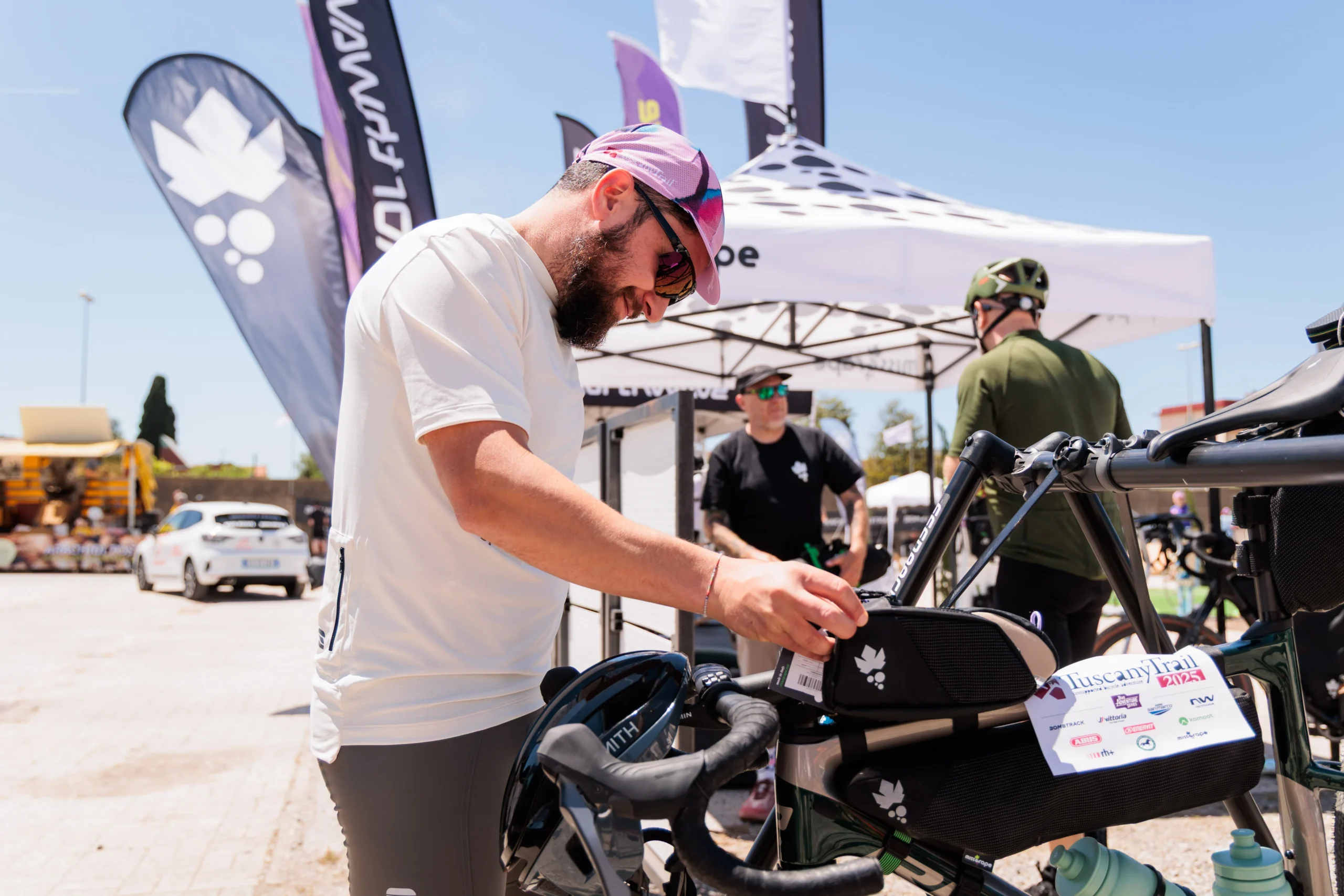
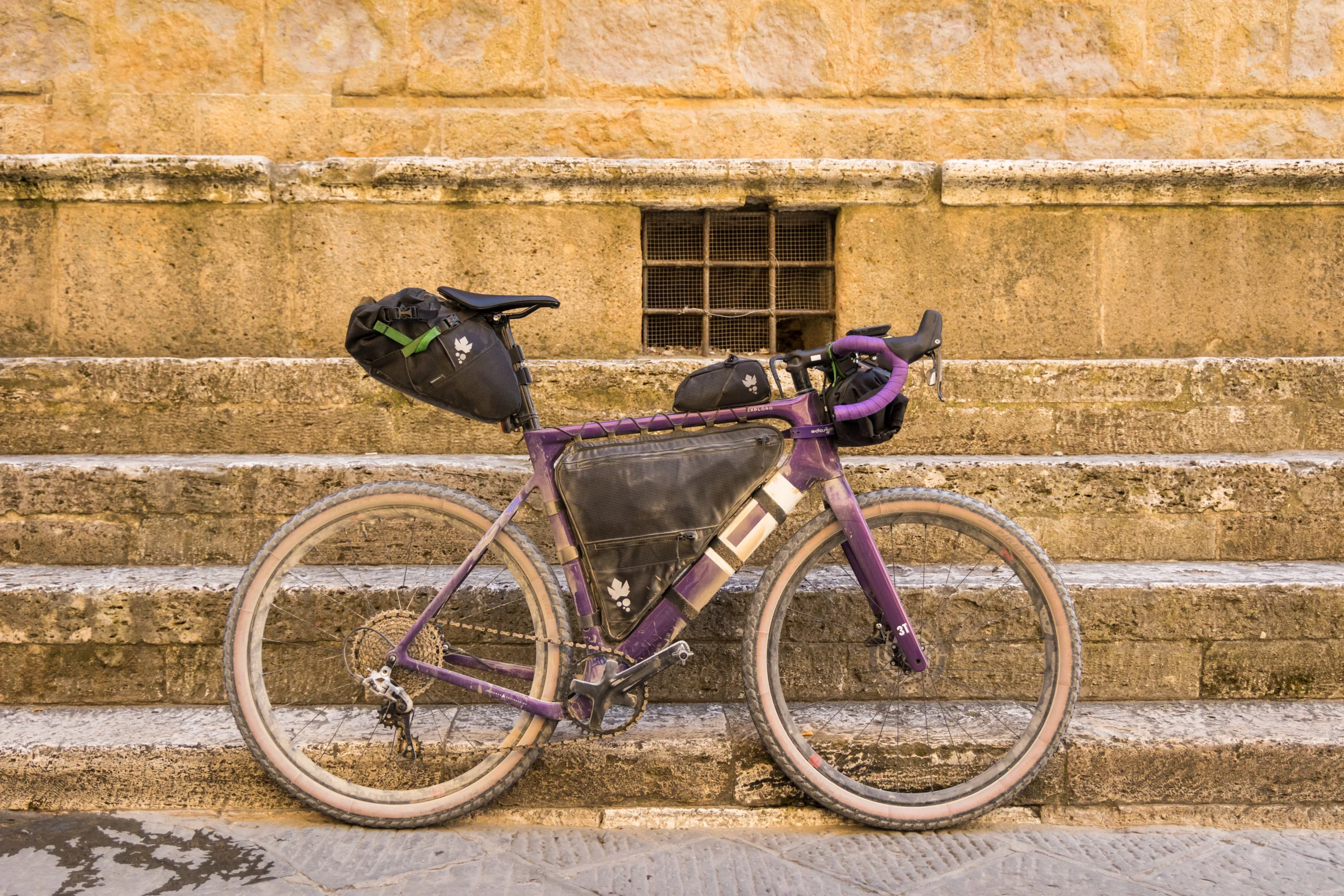
A seatpack and a frame bag. That alone is enough to tackle the Tuscany Trail without problems. Take, for example, a 20-liter waterproof seatpack like the Cluster 20 Waterproof by Miss Grape, paired with an Internode 5 Waterproof frame bag at 5 liters. We’re talking about 25 liters total. More than enough space for those choosing to sleep in hotels or agriturismos and eat at restaurants, grocery stores, or by relying on supermarkets along the route.
If you choose credit card mode—meaning light and relying on facilities—the first advantage is immediate. The bike is more fun. You weigh less, pedal more smoothly, handle better, and arrive less exhausted at the end of the day. The second advantage is less romantic but crucial. You recover better. A real bed, a shower, clean and dry kit, a sit-down dinner without watching the clock. From day three onward, this is worth as much as a well-executed winter training block.
On the other side, there will be people who, in addition to the seatpack and frame bag, will also mount a handlebar bag—for example, a Tendril 10.7 Waterproof by Miss Grape—and if the plan is to sleep in a tent using the Base Camps, they’ll add fork bags too, two Trunk 6 at 6 liters each.
In this case, we’re talking about roughly 20 liters of seatpack, 5 liters of frame bag, 10 liters of handlebar bag, and 12 liters of fork bags—so about 47 liters total.
If you choose the full kit, you’ll have total autonomy and therefore what seems like absolute freedom. No reservations, no check-in anxiety—you stop when you’re wrecked and that’s it. And in part, it’s true. It’s also why many choose it, especially when budget matters or when you want to truly feel the adventure in your bones.
The point is that freedom has a cost that isn’t just physical. It’s mental and daily. You have to think about where to sleep, where to pitch the tent, how to manage water and food. Along the Tuscany Trail route, there are Base Camps, which are a beautiful way to build community and also to save money, since some are free and others require only a minimal contribution. They’re an interesting balance between autonomy and shared experience.
The biggest difference, though, comes down to how you choose to handle overnight stays and food during the journey.
And this has direct consequences. The more gear you bring, the heavier your bike will be. Heavy means harder to pedal, more challenging on climbs, and more difficult to handle off-road. A heavy bike responds worse than a light bike. It’s obvious, but we often forget it.
So why do people tend to bring so much stuff? Because before an event, doubts are plenty.
Someone who’s never done the Tuscany Trail will tend to bring more gear than someone who’s done it five times. When you have doubts, you try to manage them with plan B, plan C, and plan D. And every backup plan translates into extra items to stuff inside the bags.
Test everything before you leave
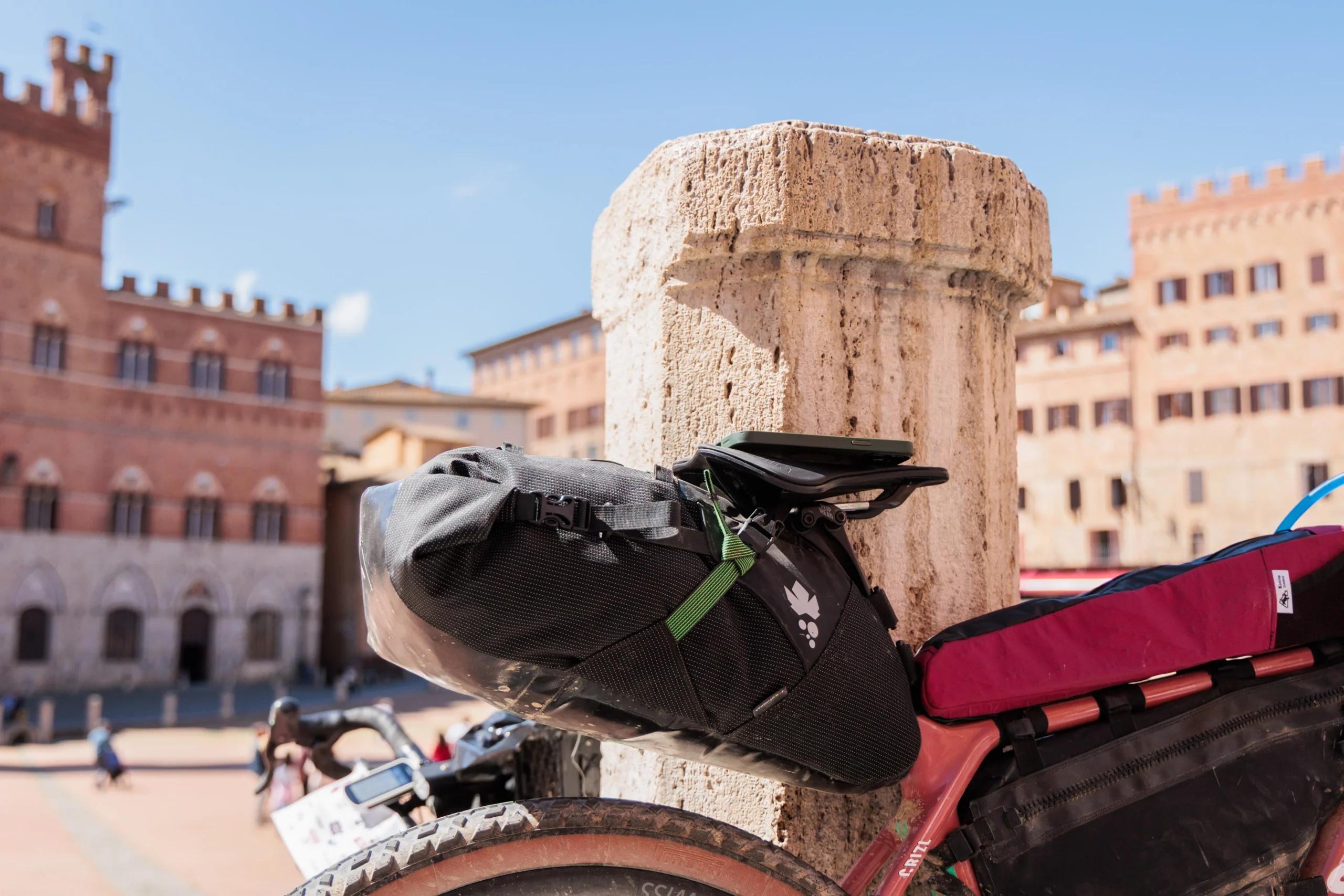
That’s precisely why there’s a rule that should never be ignored. All gear must be tested before departure. Don’t you dare test something for the first time during the journey. You need to test everything, but especially you need to test what it means to ride with the bike loaded exactly as you’ve loaded it for the event.
The risk is simple. The bag placement isn’t correct, something shifts, something rubs. You realize the bike is too heavy that way and you can’t pedal well uphill or steer it safely downhill. Maybe you figure out that with all that weight, you need wider tires for more control. Or a thousand other problems emerge that only show up when the bike is truly loaded.
Another point to consider is water management. How many bottles to bring and where to put them isn’t a minor detail. Small bags between the stem and handlebar mount like the Bud are a smart solution. You can mount two. They’re convenient for keeping items within reach, but they’re also perfect for adding two extra bottles or stuffing half-liter bottles bought along the way. You don’t always want to add extra bottle cages to the frame. This way, you have a flexible water reserve to use only when needed.
The arrangement of items inside the bags is also fundamental. Things that need to be within reach must truly be within reach. It’s obvious, but worth remembering. If it starts raining, you can’t start emptying half a bag to find your rain jacket, getting everything else wet. The jacket needs to be in an accessible position. The tool kit usually goes in the frame bag, because you open the zipper and everything’s right there.
There’s no exact science to the arrangement. But the same thing always happens. At the beginning of the journey, items are organized one way; at the end of the journey, they’re organized another way. Because over the days, you figure out how to best organize everything.
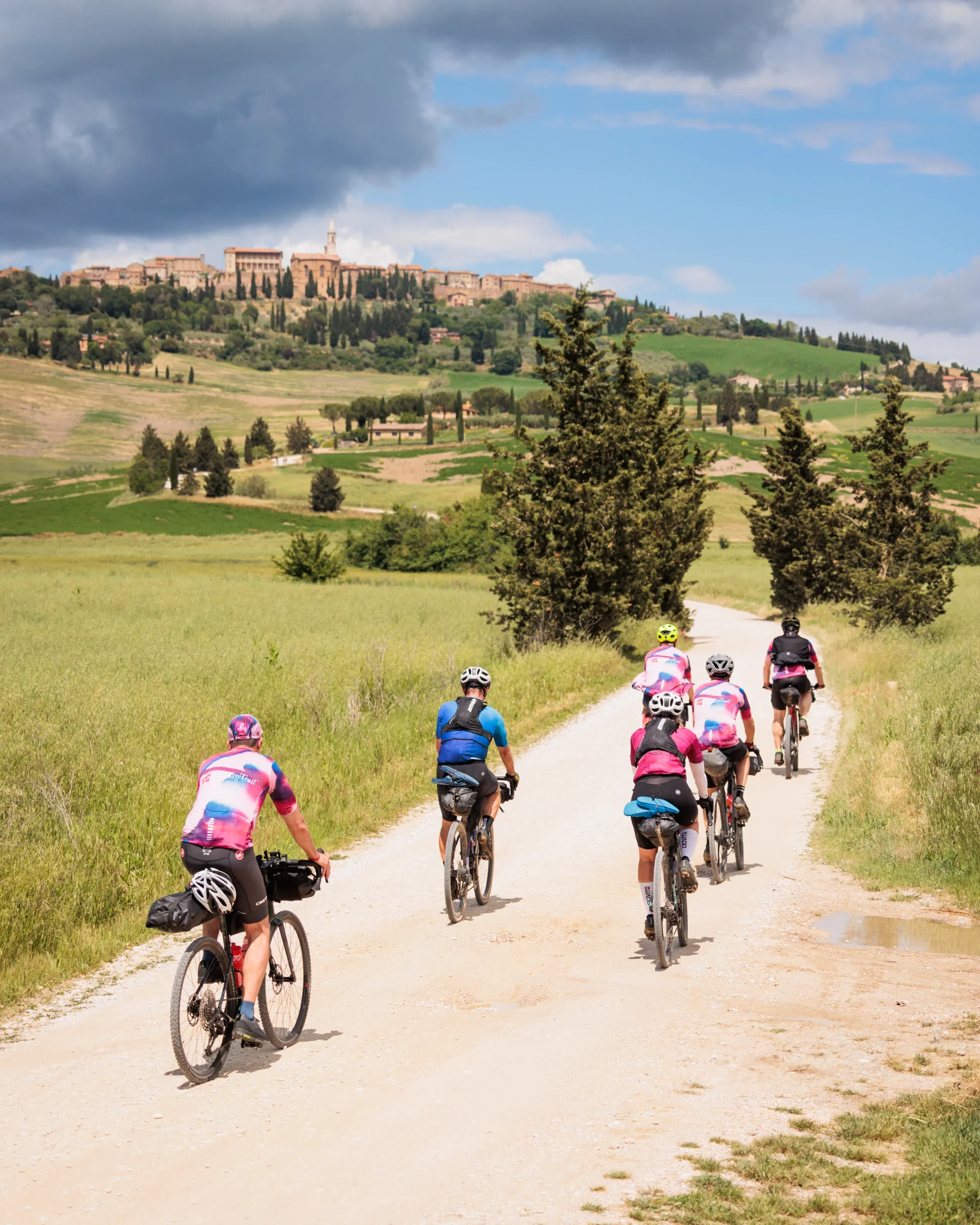
Quality makes the difference
And then there’s one last aspect that concerns bag quality.
We talk about Miss Grape not only because they’ve always been a sponsor of the Tuscany Trail, but because when it comes to gear, durability matters. These are bags made in Italy, designed to last. And this becomes even more important when traveling in remote places, but it also applies to a two-day weekend.
You can crash on a bike. If you choose a bag that’s too light to save a few grams and it tears in a fall, you have a huge problem. That’s why quality makes the difference. Misgrape bags are built to be virtually indestructible and are covered by a lifetime warranty. A choice like that says a lot.
Bikepacking bags, if bought right, are bought once. They last for years. Those who spend well once save compared to those who buy cheap products and then have to buy again.
And that’s where travel setup becomes a conscious choice, not just technical but also smart.
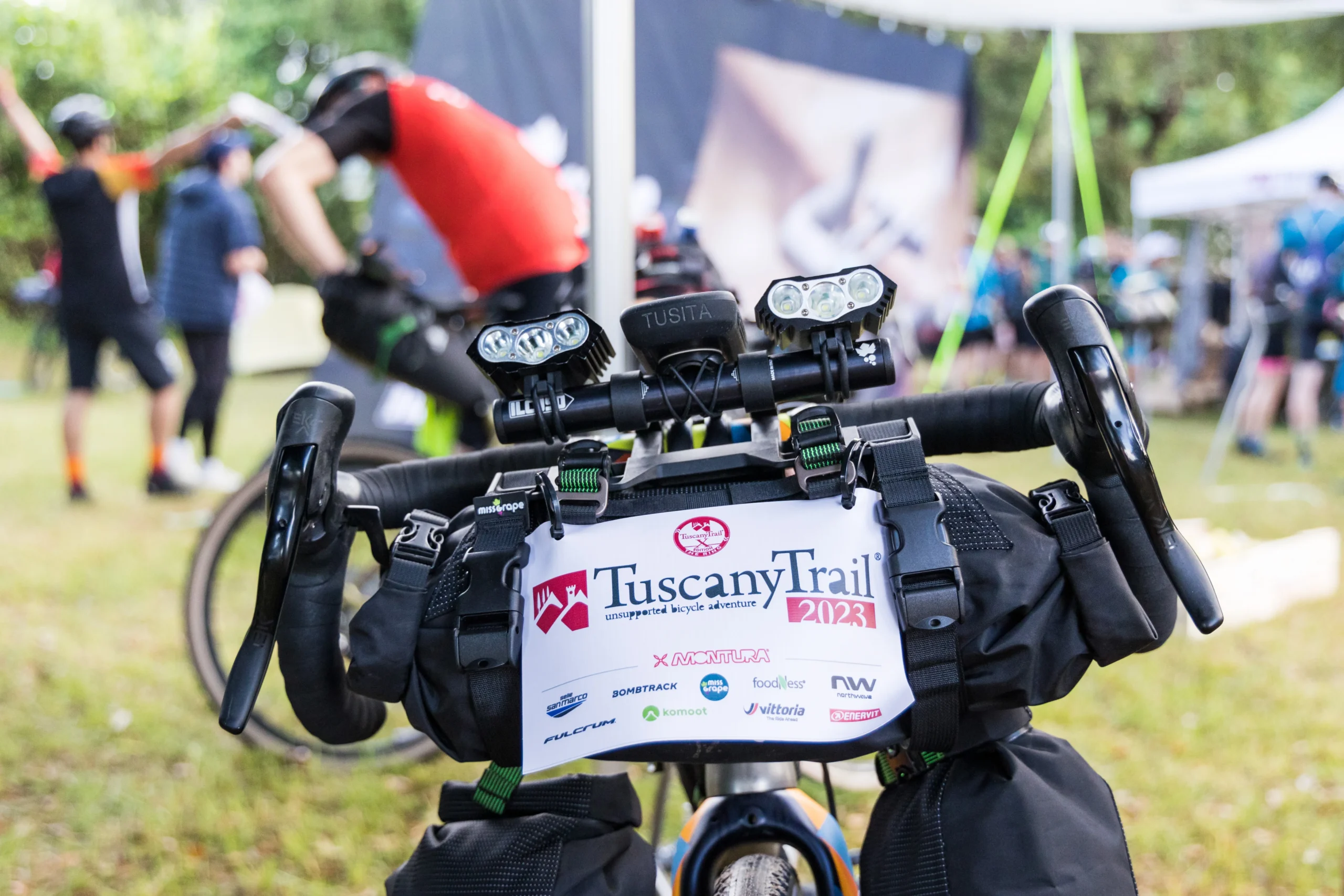
Finding your own balance
In the end, there’s no right setup and no wrong setup. There’s the setup that’s right for you, for your way of experiencing the journey, for your experience level, and for the degree of autonomy you want to have.
What truly matters is that every choice is conscious. Knowing why you’re bringing something, knowing where you’re putting it, knowing how your bike’s behavior changes when you load it. Bikepacking isn’t just pedaling—it’s also learning to simplify.
And the more experience you gain, the more you realize that true evolution isn’t adding things. It’s removing them. Because when you find your balance between lightness, functionality, and gear quality, you stop thinking about the bags and start thinking only about the journey.

Add comment