
The right tire changes the trip
— not just the bike.
If you have been riding for a few years, take a look at the corner of your home where you keep your bikes. That space — garage, storage room, hallway corner, it does not matter — where tools accumulate, bags pile up, and spare parts find a home. I am willing to bet there is a stack of tires somewhere in there.
It happens to almost everyone, sooner or later.
It starts with the fast one — smooth, low rolling resistance, great on tarmac, seems like the obvious choice. Then comes the first rough gravel day, the first time the wheels slip out, and suddenly something more aggressive ends up in the shopping cart. Then you discover that a fully knobbly tire on pavement is just unnecessary suffering. Then you find the middle ground. And then — this is where everything changes — you understand the most important thing: there is no perfect tire. There is only the right tire for that trip.
The tire becomes a variable, not a constant. You swap it on and off. You choose it based on the route, the season, the terrain. In winter, with mud and wet roads, you go more aggressive. In summer, on dry and compact gravel, you can go faster. For a mixed trip, half tarmac and half dirt, you find the right compromise.
That stack of tires in the corner is not clutter. It is accumulated experience.
The only contact point that really matters
The saddle connects the rider to the bike. The tire connects the bike to the world. Everything that happens while you pedal — traction when you push, braking when you slow down, grip when you corner, comfort when the terrain turns rough — passes through two strips of rubber a few centimeters wide.
It has always been this way. But when you turn a gravel bike into a bikepacking bike, the stakes get higher.
Bags add weight. Weight changes how the bike behaves. Impacts are felt more, handling changes, and the tire ends up doing a job it was never designed for — at least not in the standard configuration the bike came with from the shop. At that point, having the right tire is not a detail. It is the difference between a bike you ride and a bike you manage.
More weight means more responsibility for your tires
People coming from road cycling — and gravel continues to attract a lot of riders from the tarmac world — often have a very clear idea of how to choose a tire. Minimum width, high pressure, low rolling resistance. That is perfect for a gran fondo. For a bikepacking trip on gravel roads, it is the wrong starting point.
With full bags, the total system weight — bike plus bags plus rider — can easily be twenty or twenty-five kilos more than a normal ride. That weight demands more grip, more stability, more margin for error. Especially when you are tired, when the terrain is wet, when you are descending a rough gravel road after six hours in the saddle.
Choosing a tire comes down to three things:
The terrain you will actually ride. Not the ideal version — the real one. The one you find when it rains, when the dirt road turns soft, when the descent that looked innocent on the map turns out to be a loose gravel gully.
Your riding style. If you have years of mountain biking behind you, you can get away with something faster. If gravel is relatively new to you, a more generous tire gives you a margin that is worth a lot.
Your total system weight. Bike plus bags plus you. The heavier the setup, the more you need a tire that works for you rather than against you.
If you are unsure — and especially if rough terrain is not your natural habitat — the choice is simple: go wider and go knobblier. It helps far more than you expect, and it slows you down on tarmac far less than you fear.
Tubeless: not an option, the right choice
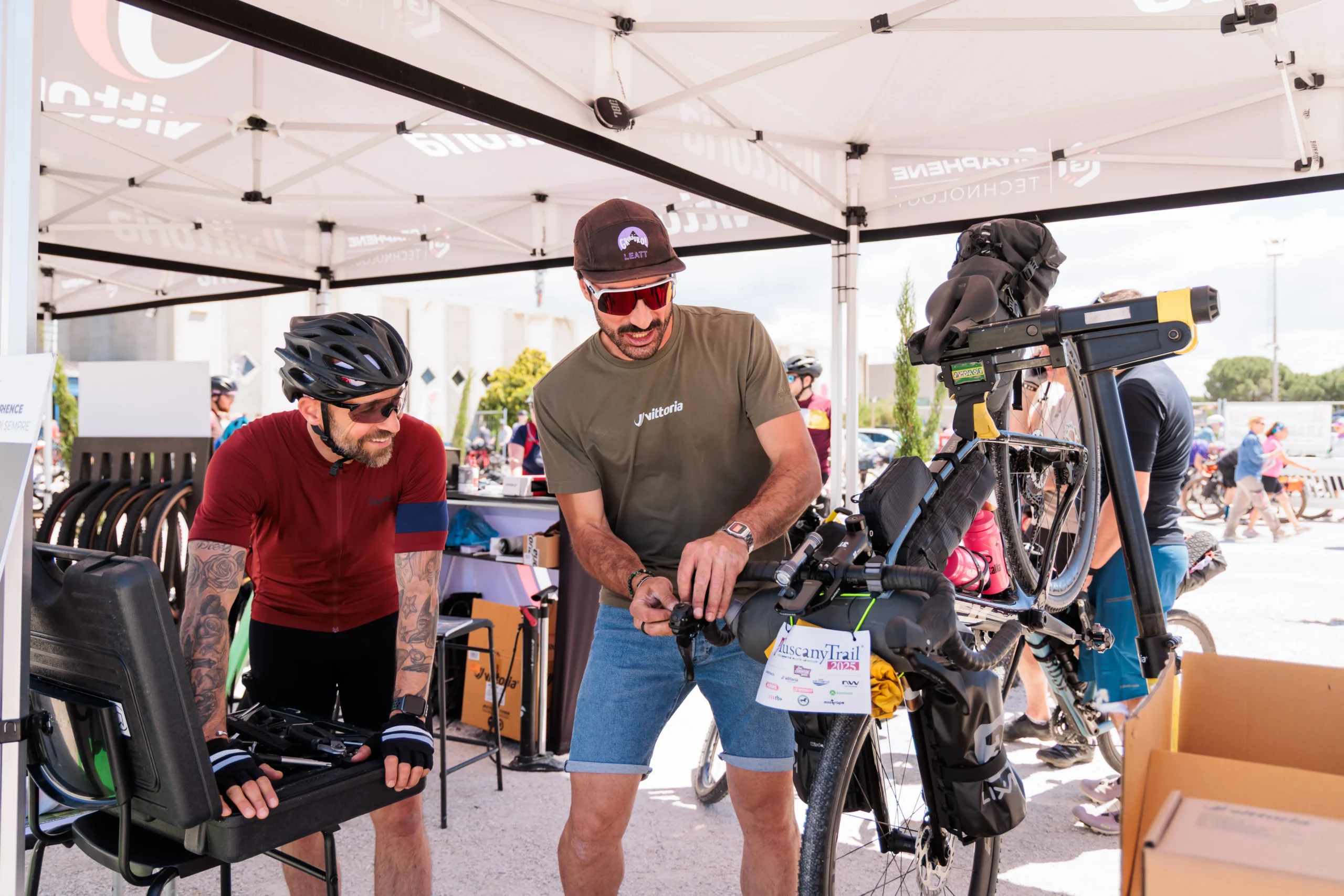
If you are planning any offroad trip — whether that is the Tuscany Trail, an Unpaved Roads event, or any route with a serious percentage of gravel — tubeless is not an enthusiast upgrade. It is simply the right call.
With a loaded bike, running inner tubes on rough terrain is an unnecessary risk. Small punctures — thorns, sharp stones, fine gravel — are handled automatically by the sealant, often without you even noticing. The tire loses a little air, the sealant seals, you keep riding.
On a long trip, every puncture avoided is time saved, stress avoided, energy preserved. And punctures on gravel with a loaded bike are not rare — they are almost inevitable if you are still running tubes.
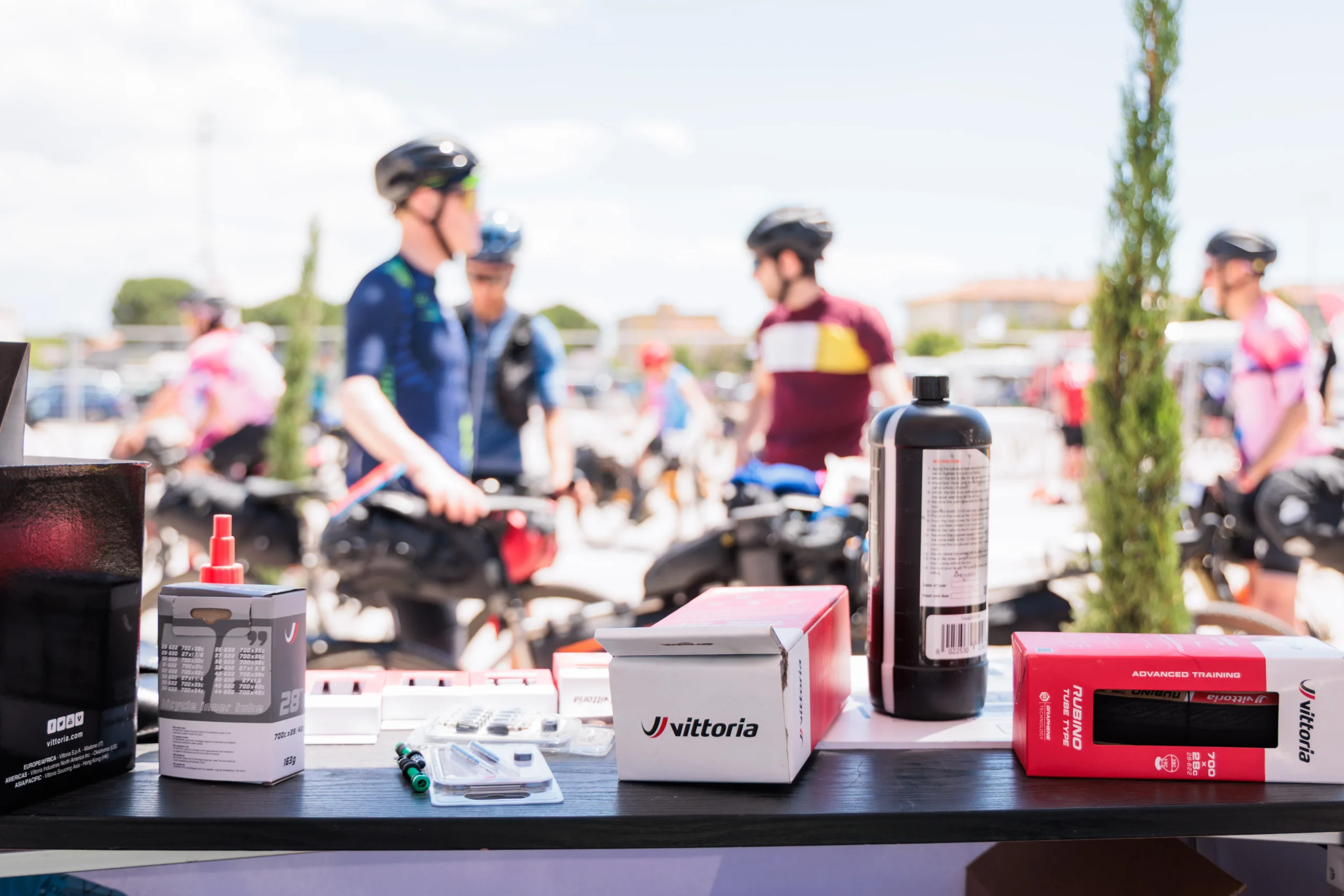
One thing is essential though: always carry at least one inner tube as backup. Even with tubeless. If the sealant cannot handle a large sidewall cut or a serious tear, you are stuck in the middle of nowhere without one. It is the lightest piece of gear in your kit and the one you will regret most if it is missing.
And carry a tubeless plug kit. This is the other thing most people forget until the first time they need it. Tire plugs — sometimes called bacon strips — are small rubber inserts that you push into a cut using a needle tool. You pull the needle out, the rubber plug stays in, and it helps the sealant close the hole from the inside. They weigh almost nothing, they take up no space, and they can save a ride that the sealant alone would not be able to fix. Consider them non-negotiable.
Pressure changes everything. Really.
For mountain bikers this is obvious. For people coming from road cycling it is often a late discovery — sometimes too late.
Tire pressure is not a fixed number printed on the sidewall. It is a variable that changes the character of the bike in a fundamental way. Lower it and the bike becomes more stable, more forgiving, more grippy on dirt. Raise it and the bike rolls faster on tarmac, but becomes nervous, uncomfortable, and less reliable when the surface gets unpredictable.
There is something else that road cyclists often take a while to fully absorb: a gravel bike has no suspension. None. All the absorption of vibrations, impacts, small holes and large ones passes through the tire. The tire is your only suspension system. Getting the pressure wrong means turning a pleasant bike into a punishment device — and this time it is not the saddle that suffers. It is your hands, your shoulders, your lower back.
The right pressure is not the one that feels right when you squeeze the tire by hand. It is the one that accounts for your weight, your bag weight, your terrain, and your specific tire.
Front and rear are not the same pressure
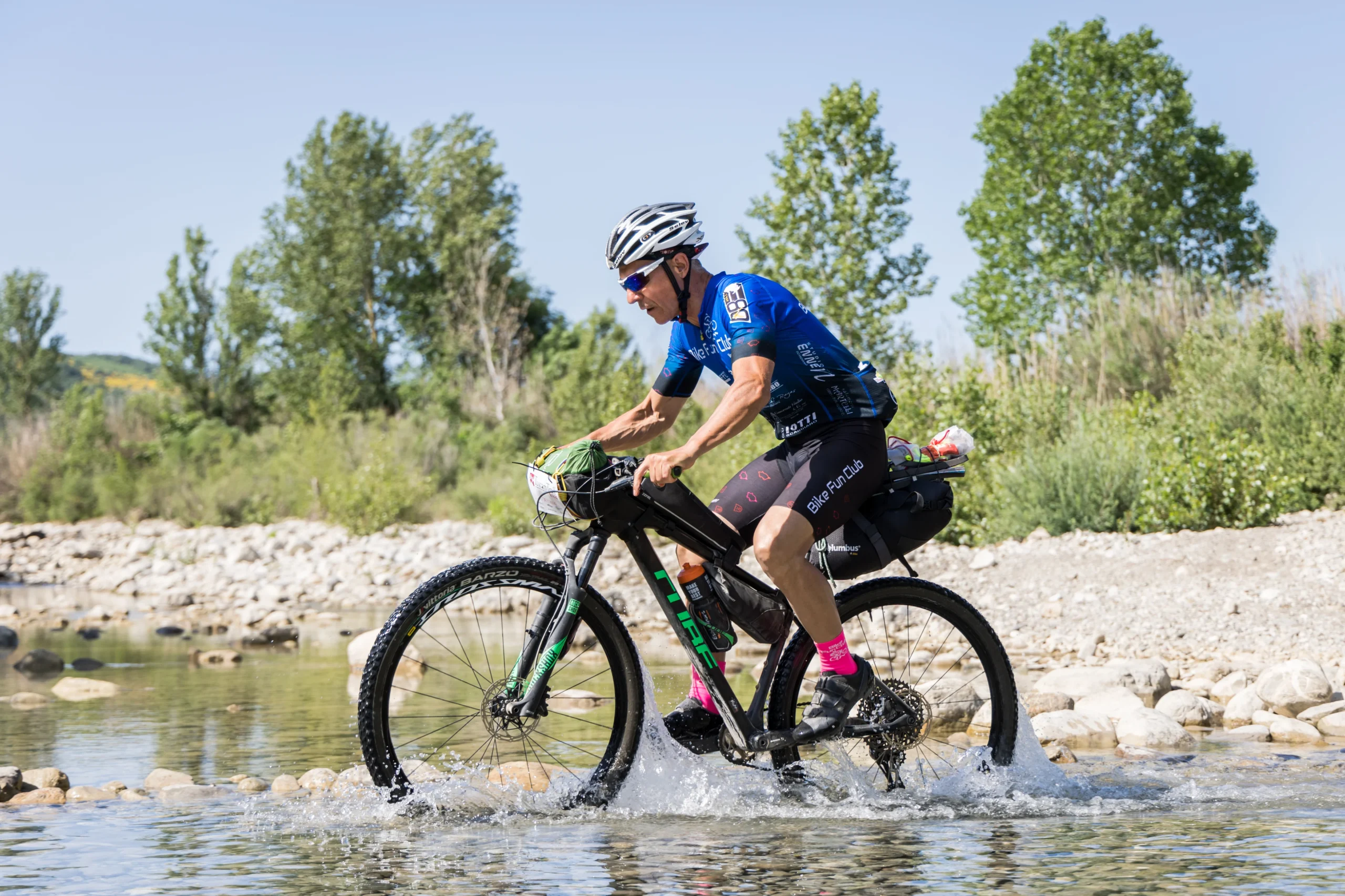
This is one of those details that makes a real difference and that very few guides explain clearly. With full bags — handlebar bag, frame bag, seat bag — the weight is not distributed evenly across both wheels. The rear wheel almost always carries more load, and needs a few more PSI than the front.
Setting both wheels to the same pressure is a common mistake. The result is a bike that tends to be unstable at the front or too stiff at the rear. Finding the right balance takes a little experience, but the starting point is always the same: rear slightly higher, front slightly lower to get more grip and absorption in the wheel that steers.
Check your pressure every morning — every morning
Calibrating pressure once before departure and forgetting about it is not enough. Tubeless tires lose pressure slowly but consistently — it is normal, it is expected, it does not mean something is wrong. But after a night in the tent, especially in cold weather, the difference from the evening before can be several PSI. Enough to noticeably change how the bike handles.
The habit of checking pressure every morning, before loading the bags and setting off, takes two minutes. And this is exactly why carrying a pump with a pressure gauge is not optional — not one of those emergency mini-pumps that barely inflate, but a real pump with a readable gauge.
The good news is that today there are genuinely compact, lightweight pumps with pressure gauges that work for both the low pressures of gravel tires and the high pressures of a road bike. They weigh almost nothing, fit in any bag, and turn pressure management from guesswork into something precise. It is one of those purchases you make once and then wonder how you managed without it.
How to find the right number — without guessing
Vittoria has built a free tool that does exactly this: it calculates the ideal pressure for your specific setup. Enter your weight, the weight of the bike with bags, the tire model, and the expected terrain — and it gives you a precise pressure range, front and rear.
You can find it here: int.vittoria.com/it/pages/tire-pressure
Before every long trip, spend three minutes entering your current numbers. Bags are fuller than last time? The weight changes. More gravel than usual on this route? The pressure changes. This is a detail that experienced bikepackers check every time, not just once.
Vittoria has been developing tires for serious riders for years — not just for racing, but for travel, for long distance, for the mixed terrain that is the daily reality of bikepacking. The combination of a well-chosen tire and a pressure calibrated to your setup is one of those things you do not feel immediately — but after a week on the road, your body knows exactly the difference.
The choice nobody regrets
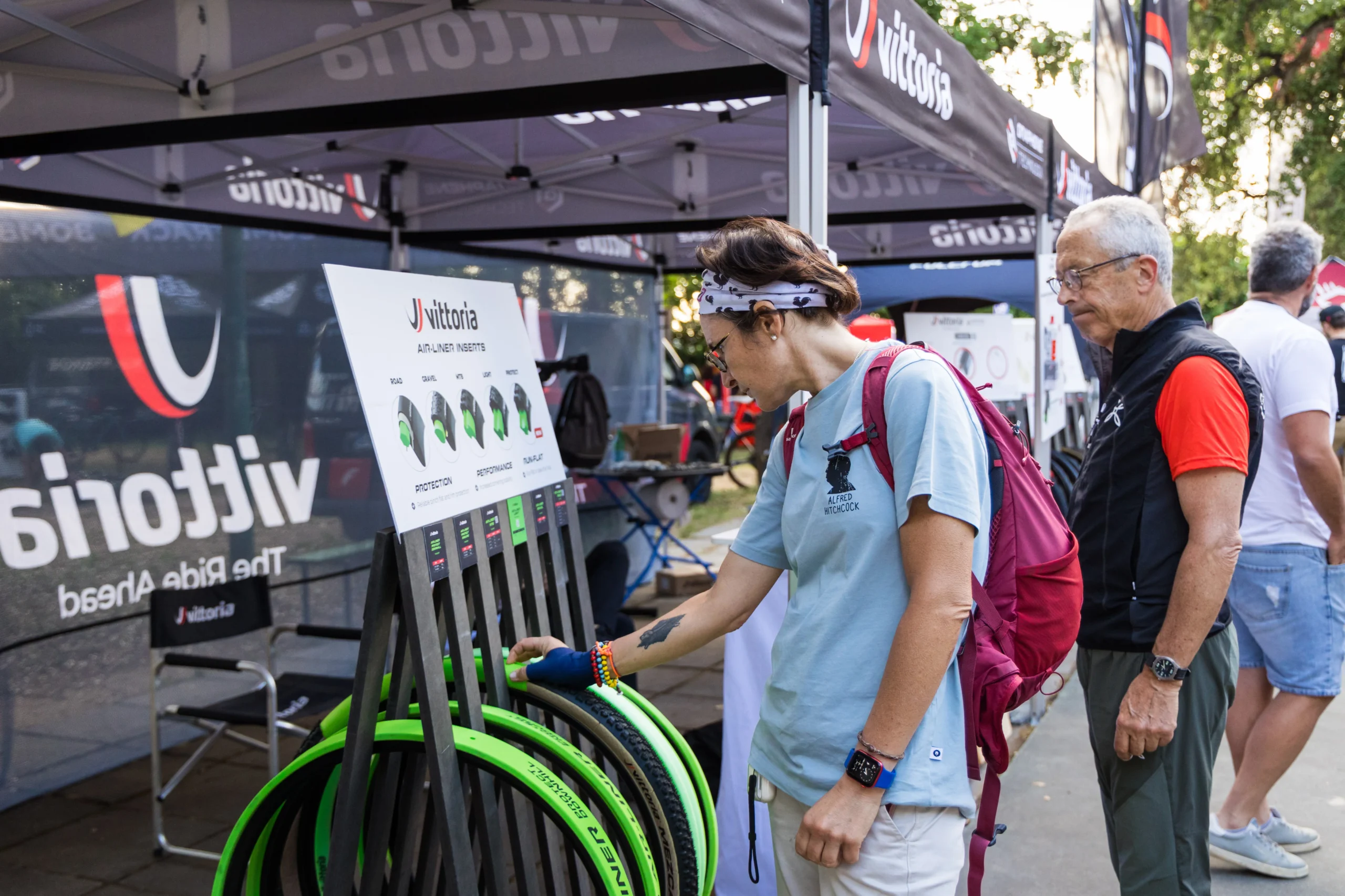
There is one thing that almost every bikepacker with real mileage has in common: at some point they stopped choosing the fastest tire and started choosing the most suitable one. That is not giving up. That is experience.
A wider, knobblier tire on difficult terrain does not slow you down — it frees you. It lets you push when a thinner tire would make you back off. It lets you handle mud, loose gravel, and unexpected singletrack without that constant tension that drains your energy before the physical effort even begins.
And at the end of the day, when you set up the tent and think back over the kilometers ridden, that is the feeling that stays: not how fast you went. But how well you rode.
The tires we use — from the white roads of Tuscany on the Tuscany Trail to Northern Europe — are Vittoria. If you want to know where to start, the pressure tool is the first step: int.vittoria.com/it/pages/tire-pressure

Add comment